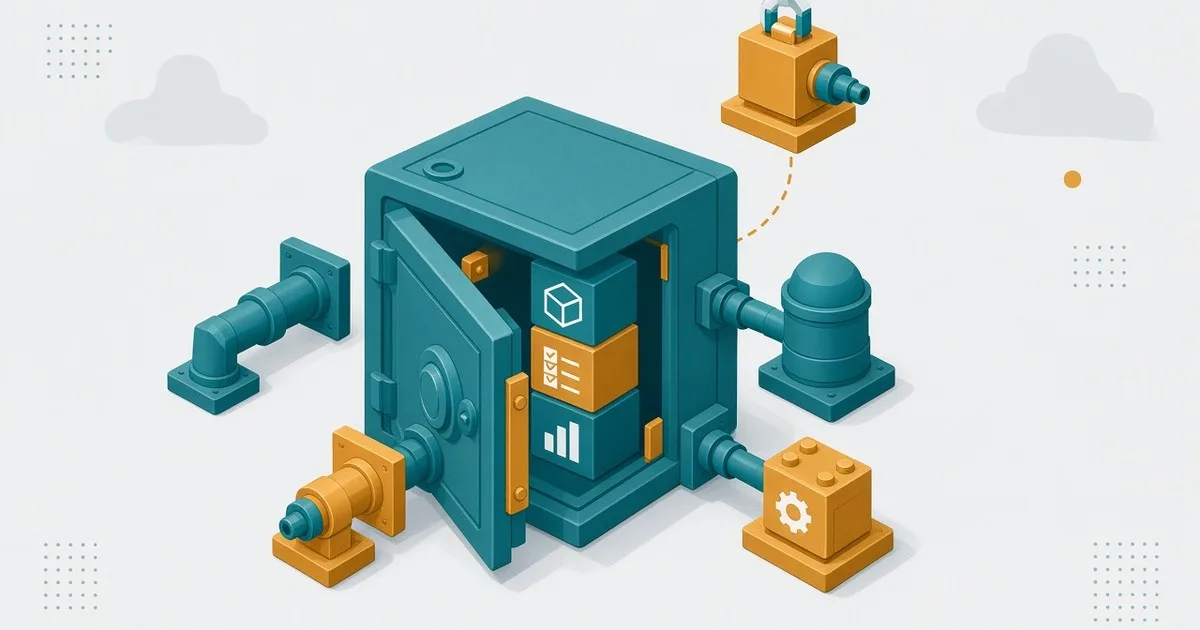
The Fivetran and dbt merger, completed on June 1, 2026, changes who sells your ingestion and transformation tools, not who owns your business logic. Keep model SQL, tests, metric definitions, freshness rules and source contracts in a repo you control. Treat connectors, runtimes, caching and agents as services you rent.
That split matters because one vendor now ships ingestion, transformation, data quality tooling and even dashboards. Convenience goes up. So does the cost of not knowing where your own logic lives.
This guide covers what actually changed, what still belongs in your repo, what is fine to rent, and a short exit test you can run this week. Here is the ownership boundary, layer by layer.
What the Fivetran and dbt merger changed
The deal is now a single company with one roadmap. Fivetran and dbt Labs announced the all-stock merger on October 13, 2025, saying the combined company would be approaching $600M in annual recurring revenue.
The merger closed on June 1, 2026, according to the Fivetran press release. George Fraser stayed CEO, Tristan Handy became President, and the company says it serves more than 100,000 data teams.
The open source position is clearer than many teams feared. In its September 16, 2026 dbt Summit release, Fivetran + dbt Labs said dbt Core is now dbt v1, Fusion has become dbt v2, and both remain Apache 2.0 licensed and security supported.
There is a packaging detail worth reading twice. The dbt Labs Summit recap says v2 ships as two distributions: dbt, which is free with optional paid features such as dbt State, and dbt-oss, which includes only the Apache 2.0 components.
The same group has also been rearranging the open source map around it:
- SQLMesh, contributed by Fivetran, joined the Linux Foundation on March 25, 2026 to run under vendor neutral governance.
- Fivetran announced on May 13, 2026 that it plans to become steward of the Great Expectations open source community and the GX Core project.
None of this forces a migration. It does mean the ingestion, transformation, testing and semantic layers in many stacks now trace back to one commercial owner.
Why the ownership boundary matters more now
A merged vendor is not a problem by itself. The risk is architectural: when every layer comes from one place, nobody on your team writes down which parts are yours.
You find out during a contract renewal, a license change, or a migration to a different warehouse. At that point, logic that lived in a vendor UI is expensive to recover.
The vendor's own pitch supports drawing this line. In the September release, Chief Product Officer Anjan Kundavaram said every model, test and metric customers have built "already captures the context AI agents need." That context is exactly the asset you should hold in your own version control.
What still belongs in your repo
Use one rule: if losing it would change a number on an executive dashboard, it lives in a repo your team controls, with history and code review.
1. Model SQL and the dependency graph
Your models, macros and the refs between them are the business logic. They should build from a clean checkout with the open source distribution alone, not only inside a hosted IDE.
2. Tests and data contracts
Uniqueness, not null, accepted values and relationship tests encode what your team decided is true. Producer facing contracts belong here too, as we argued in data contracts that make producers own what they emit.
3. Metric definitions
Revenue, active customer and churn should be defined once, in code, and referenced everywhere else. This is the core of a single source of truth for analytics, and it should never exist only inside a BI tool.
4. Freshness requirements
dbt State moves freshness from the job to the model. The dbt Labs recap says each model can carry a lag_tolerance in code that says how stale it may be.
That is a good pattern. Keep the tolerance values in your repo, reviewed like any other change, even if the feature that reads them is a paid one.
Field notes on unifying data, governance and getting analytics teams to one source of truth.
Every Monday, five minutes.
5. A written source inventory
List every source, table and sync schedule your models depend on, plus the owner on each side. Connector setup can stay in the vendor console, but the dependency list cannot.
What is fine to rent
Renting is a reasonable choice for anything you can replace without rewriting logic. The test is simple: could you swap it within a quarter while keeping every model, test and metric unchanged?
| Layer | Keep in your repo | Fine to rent |
|---|---|---|
| Ingestion | Source inventory, expected schemas | Connectors, sync scheduling |
| Transformation | Model SQL, macros, refs | Hosted runtime, IDE |
| Quality | Tests, contracts, thresholds | Alerting and run history |
| Cost control | Freshness tolerances | Build caching such as dbt State |
| Semantics | Metric definitions | Query APIs and agent integrations |
Caching is the clearest case. dbt Labs says dbt State averages a 15 to 30 percent or larger cut in warehouse compute, and RxBenefits reported 59 percent lower warehouse cost on scheduled jobs.
Those are vendor and customer figures, not independent benchmarks. They are still a fair reason to rent the feature, because your models keep working if you turn it off.
If cost is the main driver, pair this with the levers in cutting data pipeline cost without breaking freshness before you change tools.
Run the exit test this week
You can check your exposure in one afternoon. Work through these in order:
- Clone the repo on a clean machine and build it with the Apache 2.0 distribution only.
- List every feature in your daily runs that needs a login or a paid tier.
- Confirm every metric used on a dashboard is defined in the repo, not in the BI tool.
- Check adapter status: as of dbt Summit, dbt Labs listed BigQuery, Databricks, DuckDB, Redshift and Snowflake as GA on v2, with Athena, Fabric and Postgres coming soon.
- Write down who owns each source system and each freshness tolerance.
Anything that fails step 1 or step 3 is logic you do not fully own yet. Fix that before your next renewal, not during it.
Keep the logic, rent the plumbing
The merger made one vendor responsible for more of the stack. Your job is to make sure the parts that define your numbers stay in code you own, so any service around them stays replaceable.
A managed data platform should work the same way: it runs your models and pipelines, while the logic stays in your repo. Book a demo to see a managed data platform running on your own sources.
Frequently asked questions
Is dbt Core still open source after the Fivetran merger?
dbt Core is still open source under Apache 2.0. Fivetran + dbt Labs renamed it dbt v1 and says both v1 and v2 remain Apache 2.0 licensed. Some optional features, such as dbt State, are paid.
When did the Fivetran and dbt merger close?
The Fivetran and dbt merger closed on June 1, 2026. It was first announced on October 13, 2025 as an all-stock deal, with George Fraser as CEO and Tristan Handy as President of the combined company.
Do I have to migrate from dbt v1 to dbt v2?
Migrating to dbt v2 is not required right away. Fivetran + dbt Labs says v1 remains security supported. Check that your warehouse adapter is GA on v2 before planning a move, since Postgres, Athena and Fabric were listed as coming soon in September 2026.
What is dbt State?
dbt State is a build caching feature that checks warehouse metadata and model SQL, then builds, skips, clones or defers each model. dbt Labs says it runs on dbt v1.7 through v2 and is an optional paid feature.
Should we move off dbt because of the merger?
Moving off dbt rarely fixes the real risk. If your models, tests and metrics already live in your repo, switching tools later stays possible. SQLMesh, now under the Linux Foundation, is one vendor neutral option teams can evaluate.
Is SQLMesh still controlled by Fivetran?
SQLMesh is now a Linux Foundation project. Fivetran contributed it on March 25, 2026, and it runs under vendor neutral governance, with initial project members including Benzinga, CloudKitchens and Harness.
Book a demo to see a managed data platform running on your own sources
LensAIght
- fivetran.com/press/fivetran-dbt-labs-complete-merger-to-create-the-data-infrastructure-for
- fivetran.com/press/fivetran-and-dbt-labs-unite-to-set-the-standard-for-open-data-infrastru
- getdbt.com/blog/fivetran-and-dbt-are-one-company-now-here-s-what-that-means
- fivetran.com/press/fivetran-dbt-labs-announces-new-capabilities-to-make-enterprise-data-ag
- getdbt.com/blog/dbt-summit-2026-product-announcements
- linuxfoundation.org/press/linux-foundation-welcomes-sqlmesh-project
- fivetran.com/press/fivetran-to-become-steward-of-the-great-expectations-open-source-commun